Reprinted from the Times of Israel
September 1, 2025
Byline: Sue Surkes
New Families are Heading to Gaza Border Communities
‘The answer to Hamas is to hold on harder to the land,’ says Uriel Raisch, who moved with his family to secular-religious Kibbutz Kerem Shalom. ‘We are one people’
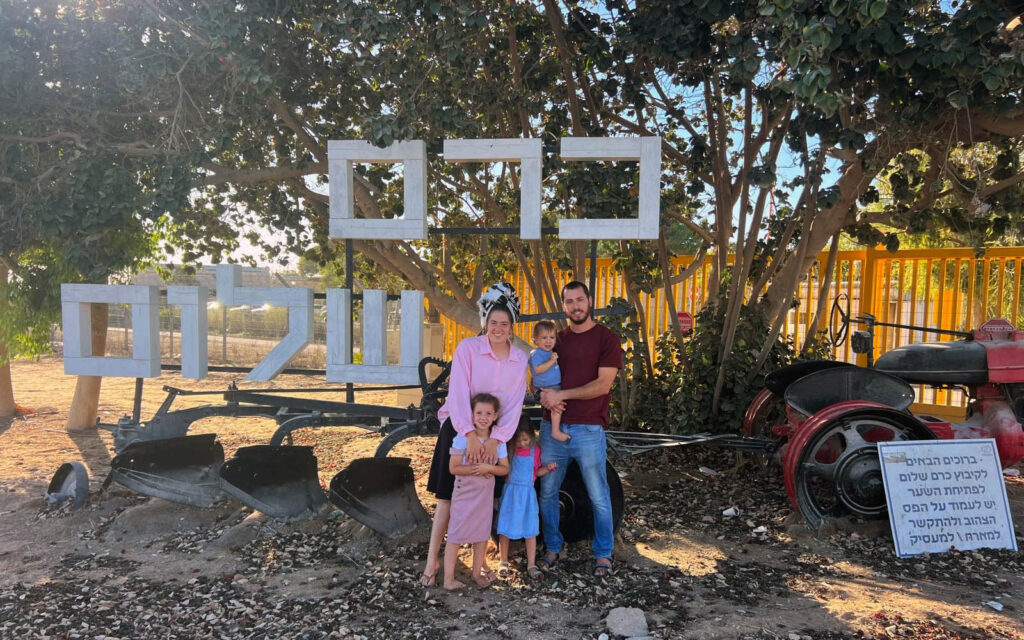
The Raisch family on new home ground in Kibbutz Kerem Shalom, close to the Gaza and Egyptian borders.
Two weeks ago, Uriel and Rachel Raisch left their home in the southern Negev town of Mitzpe Ramon and moved, with their three young children, to Kibbutz Kerem Shalom. The kibbutz is adjacent to the Gaza border and just a few hundred meters from the Egyptian border. It is next to one of the main crossings into the Gaza Strip.
“We see a lot of movement by the army and hear lots of explosions,” Rachel told The Times of Israel in an interview.“After 100 days of reserve duty in Gaza, Uriel doesn’t notice the explosions. The children know the IDF is making them.” She went on, “We had heard that the kibbutz was very beautiful and green. and still feel as if we’re on vacation. People from the kibbutz always said life here is 99 percent heaven and 1% hell. After what the Israeli army has done, it’s closer to 99.5% heaven.”
The Raisches — Uriel, 28, who is studying industry and management in Beersheba, social worker Rachel, 27, Leshem,5, Shir, 3, and Ofek, 1 — are one of five families, both religious and secular, to have joined the kibbutz in recent weeks.
Uriel, one of 11 children, was born in the Gush Katif settlement bloc in Gaza, which was evacuated in 2005 as part of Israel’s unilateral disengagement plan. Rachel grew up on Moshav Kfar Maimon, near the southern town of Netivot.
“We’re from the Negev,” Uriel explained, when asked why the family had relocated to Kerem Shalom, “and we were attracted to the idea of a community for religious and secular people.”
“We can’t forget the period we’re in,” he continued. “The answer to Hamas and terrorism is to strengthen settlements’ hold on harder to the land. We are one people, we are all brothers and sisters. We saw that the enemy doesn’t distinguish between us. Here, on the kibbutz, they don’t ask what we believe or what we are. We lead a community life together. We believe in the army and that there will be complete security here.”
Around 85% of the original 200 residents of Kibbutz Kerem Shalom have returned home. Just two families have decided not to do so.
On October 7, 2023, pitched battles took place in the kibbutz, leading to the murder of two fathers and civilian security team members — Amichai Witzen, 32, and Yedidia Raziel (Rosenberg), 31. They died trying to kill the terrorists attacking the home of a young social worker, Amichai Shindler, 33.
Elsewhere along the Gaza border, figures provided Monday by community spokespeople were as follows:
Kibbutz Nirim: 80% of the residents have returned home, and around 15 new families are expected to join in the near future. On October 7, 2023, five civilians were murdered inside the kibbutz, while five others were abducted toGaza. Of the latter, three were released in November 2023, while the other two were murdered in captivity and their bodies later recovered by the military.
Moshav Netiv Ha’asara: Just over 80% of the 1,050 residents (315 households) who lived there before October 7, 2023, have returned. There are 54 families and households still residing outside of the moshav, and it is not known when they will return. Around a dozen new families and couples are renting homes. Seventeen residents were murdered by Hamas gunmen, including three members of the local security team.
Kibbutz Sufa: Over 90% of residents are back, and five new families are being integrated into the kibbutz. During the Hamas attack, three people were murdered — two members of the kibbutz’s standby security squad and one civilian resident.
In Nahal Oz, located just 800 meters (2,625 feet) from the Gaza border, only 45% of members and residents have returned. Earlier this month, the High Court of Justice rejected a petition filed by the kibbutz against the government’s decision in June to end state funding for the temporary housing they had been living in since the October 7, 2023, Hamas assault.
Ilan Morag, chairman of Nahal Oz, said that around 50 households had returned, with 175 people, includingapproximately 60 children. Those who had not yet returned home included seniors in an assisted living facility in BatYam, central Israel, as well as families with children, particularly small children, he explained. Around 25 families were still living in Kibbutz Mishmar HaEmek, to which they were evacuated after October 7, with others scattered elsewhere.
On October 7, 2023, 13 residents and four security personnel were killed in Nahal Oz, and eight civilians were taken hostage. Kibbutz Kissufim residents are not expected to return until November, once renovations are complete. There, nine Israeli civilians and six foreign workers were murdered by terrorists in the kibbutz on October 7, and another Israeli was abducted to Gaza, murdered, and returned to Israel in a deal with Hamas. Israeli forces mistakenly killed one more Israeli civilian from Kissufim during the fighting. Twenty-seven IDF soldiers and one member of Kissufim’s local security team were killed in the fighting in the kibbutz and at a nearby army post.
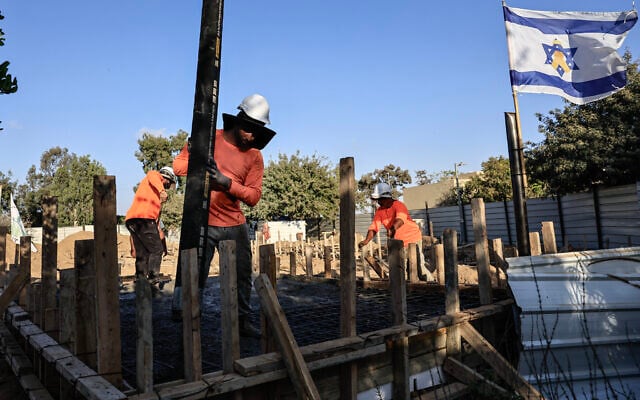
A ceremony marks rebuilding in Kibbutz Nir Oz, August 7, 2025, almost two years after the October 7 massacre.
Residents of Holit, Kfar Aza, and Be’eri are expected to go home sometime next year, while renovations at Nir Oz are only just starting. Out of some 200 people who had made Holit their home, 15 were murdered on October 7, 2023. Two Bedouin Israelis who were working in the cowshed were kidnapped and later slain. In Kfar Aza, 62 residents and 18 security personnel were killed on October 7, and 19 civilians were taken hostage.
Two hostages from Kfar Aza were later mistakenly killed by Israeli troops as they tried to escape their captors inGaza; 15 have been returned in hostage deals with the terror group, and two remain captive in the Strip — twins Gali and Ziv Berman. In Be’eri, 101 civilians (one in 10 residents) and 31 security personnel were killed, and a further 30residents and two more civilians were taken hostage.
Nir Oz was the worst affected of all. The kibbutz was largely destroyed on October 7, 2023, when Hamas terrorists entered all but six of over 200 homes in the small community and either murdered or kidnapped one of every four residents — 117 people out of some 400. Of those abducted, nine are still being held in Gaza, of whom five are believed to be still alive. A ceremony marks rebuilding in Kibbutz Nir Oz, August 7, 2025, almost two years after the October 7 massacre.
Immediately after the Hamas invasion, which saw some 1,200 people in southern Israel slaughtered and 251 abducted to the Gaza Strip, the state evacuated 46 rural communities and the city of Sderot — all of which fall within seven kilometers (4.3 miles) of the Gaza border.
By the end of May 2025, the Tekuma Directorate said that 92% of the population had returned home. These remain the most up-to-date figures.
In the Eshkol Regional Authority, whose communities were hit hardest on October 7, 2023, 3,134 pupils returned to school on Monday, compared to 2,519 last year. However, the figures have not returned to the level they were before the war. In September 2021, for example, the most recent year for which the Central Bureau of Statistics published figures, 3,583 children attended class.
Original post is here