

How Cows Avoid Stress and Produce More Milk
Dr. Maya Zechut says that the goal of her research is to ensure the welfare of cows and explain why they are given hot chili and green tea.
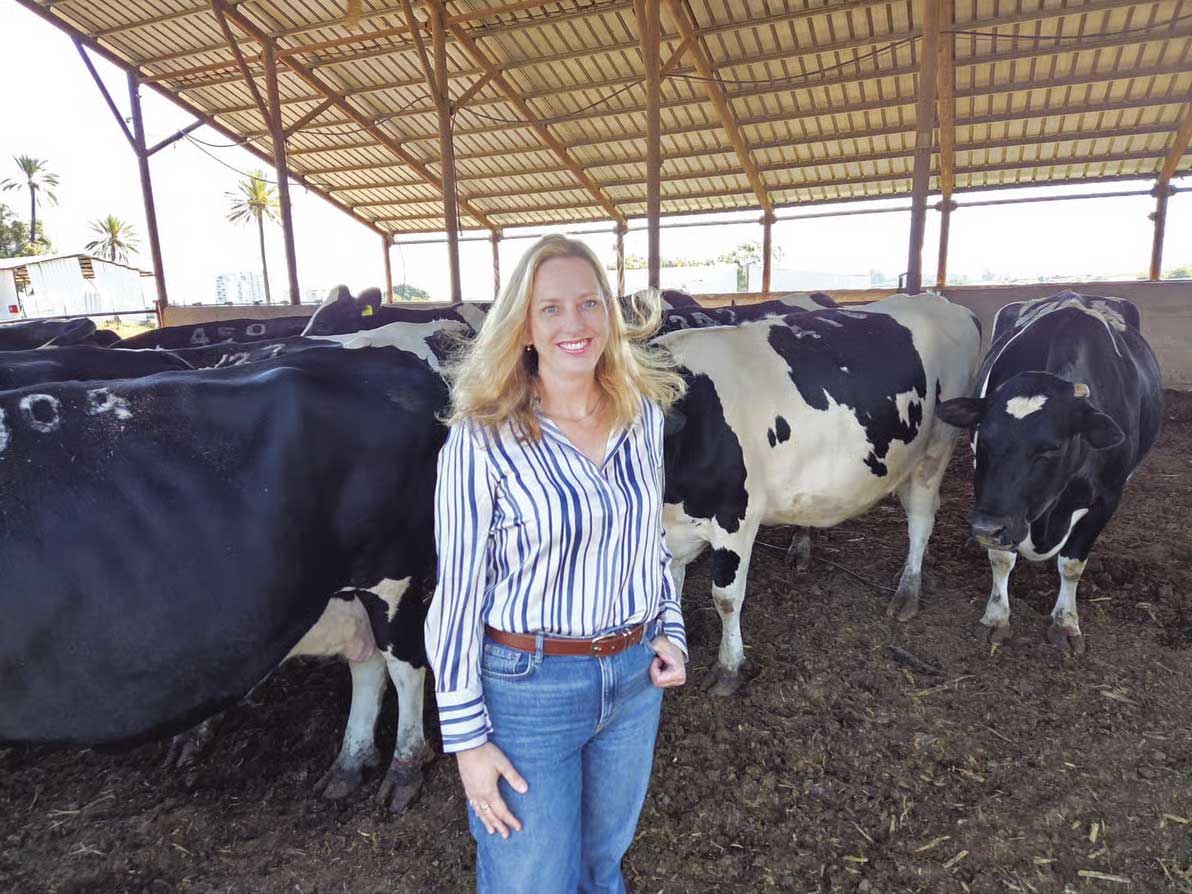
Cows have an inspiring resilience, according to Dr. Maya Zachut. Photo: Michal Goldberger Ben-Zvi
Dr. Maya Zachut, from Rishon LeZion, is married and the mother of three. She has a bachelor’s, master’s, and doctoral degree in animal sciences from the Faculty of Agriculture of the Hebrew University (her research took place at the Volcani Institute). She is the Head of the Department of Ruminant Sciences at the Volcani Institute, the largest agricultural research institute in Israel.
What are you researching?
“The physiology of dairy cows, with an emphasis on stress. My research deals with characterizing the physiological state of the cow using various indicators and developing nutritional and environmental measures to improve the functioning of her immune system, fertility, welfare and health.”
Israeli cows are top milk producers. How does this affect them?
“Dairy cows in Israel are a kind of ‘super athletes,’ and just as an Olympic athlete has a team of doctors and nutritionists, I see myself as part of the cow’s support team. Our department at the Volcani Institute has 12 researchers who work on all aspects of research on dairy cows – from nutrition and genetics to environmental and reproductive effects. My role is to improve the cow’s living conditions and environment and to take care of her well-being. The better the cow is, the better the quality of her milk will be, and the consumer will benefit.”
What are the main difficulties that a cow faces in Israel?
“The first is the heavy heat load in the Israeli summer. It is difficult for cows to cope with these temperatures, which leads to a decrease in milk production and a significant impact on fertility. Today, with global warming, Israel is at the forefront of research into improving the way dairy cows cope with heat load conditions.
The second challenge is the period around calving, which is a period of enormous physiological stress. I find myself thinking a lot about women in this context – a cow carries a nine-month pregnancy, just like a woman, and the changes she goes through are similar. We are trying to find ways to ease her through these critical points.”
According to your research, how can you relieve a cow suffering from a fever?
“We take an integrated approach. On the one hand, physical measures such as showering. A study we conducted showed that when you increase the number of showers from three to six times a day, for about 45 minutes each time, the level of the stress hormone (cortisol) decreases and the immune system functions better. At the same time, we are researching nutritional solutions. We discovered, for example, that certain components in herbs improve the cow’s condition. One example is hot chili peppers.
Just as humans in hot countries eat hot peppers to cool down, in the cow, too, chili activates certain receptors that help her regulate her body temperature. We also give them green tea extracts and other antioxidants, which are just like the nutritional supplements that people take to strengthen the body during difficult times.”
You mention a lot of similarities to humans. Is that intentional?
“Certainly. The physiological mechanisms are similar. In my PhD, for example, we gave cows omega-3 fatty acids, exactly what is recommended for pregnant women, and we proved that it improves the quality of eggs and the function of the ovaries. I am not at all offended when women are compared to cows – I admire this animal. A cow is a strong and smart animal, with the intelligence of an average dog. They have a resilience that inspires. A cow is like a strong woman who works hard, does what is assigned to her with her head held high and with joy of life, despite the workload.”
How do you tell if a cow is stressed?
“In nature, cows are prey animals. If they showed they were stressed, they would come and eat them. One of my challenges is to see beneath the surface who is less well and help them. We use sensors on the cow’s body that continuously transmit parameters that indicate her condition, such as changes in body weight and estrus time. The more a cow lies down, the better. In addition, we measure stress using biomarkers, sensors and indicators in the blood and in the milk.”
Does increased milk production not harm the cow’s welfare?
“In Israel, awareness of animal welfare is very high. We have procedure books, an ethics committee, and close supervision. Dairy cows in Israel even have medical insurance. Visitors from the United States are amazed by this, because many people there do not have such medical coverage. The interest of the researcher and the dairy farmer is the same: that the cow be well. If she is stressed, her immune system is damaged and she is vulnerable to infections. My goal is prevention. I say that if a cow has reached a point where she needs a doctor, we have failed in prevention.”
Doesn’t separating the calf from the mother immediately after calving harm the cows?
“This is indeed a weak point in terms of welfare, and we are working on solutions. But the reality is complex: a calf is born without antibodies in the blood and needs colostrum (first milk) immediately to survive. With evolution, the maternal instinct of the dairy cow weakens, and sometimes the mother does not care for the calf optimally or does not allow it to suckle. If we do not intervene and do not give the calf the colostrum ourselves, it may die.
Studies also show that if they are left together for two weeks and then separated, the pain for both is much greater. This is a dilemma and many research teams around the world are looking for the most objective way that will benefit everyone. Several studies currently being conducted in Israel are examining leaving the calves with their mothers for different periods of time and the implications for the well-being of the mother and the calf.”
Who are your subjects in the research? What kind of cows are we talking about?
“The research work is mostly done in the Volcani Institute’s experimental barn, but some of the experiments are carried out in commercial barns. We work with farmers from all over the country.”
Many dairy farms in Israel are in conflict zones. How does this affect the cows?
“October 7 was a huge trauma. 14 people from our industry were murdered that day, and dairy farms in the area were severely damaged. A researcher from my department is collecting data from the cows that survived to examine the long-term effects of this stress on their fertility and health. We know that there is ‘intergenerational transmission’ — if, for example, the mother was under heat stress or stressed during pregnancy, it affects her daughters and granddaughters. We are investigating whether this happened here too. We have a huge sense of mission to rehabilitate the dairy farms in the area and in the north. Our dairy farmers are in a world league, incredibly dedicated people who go out to milk in any situation. It is important to us as an industry that Israel can produce milk independently.”
Do you drink milk yourself?
“Sure, I really love milk and its products. Science doesn’t yet know how to even measure all the good ingredients in milk. I believe that it is an essential product for human health. My research is not about increasing yield. My focus is on ensuring that this production is done with maximum care for the animal. I want to continue to see cows in the world, and my small role is to make sure that they live here in well-being and dignity.”
Footnote
“In the cattle industry, we study females. The males are less important. As a researcher, I see aspects that male researchers may understand less: pregnancy, childbirth, and lactation. I identify with the subject of my research on a level that adds more insight into what she goes through. In the department that I run at the Volcani Institute for Cattle and Sheep Research, there are three other female researchers. There are many female dairy farmers in Israel, and some of them run the leading dairy farms.”
Read the full article here.